

Summary
A wave of potential or widely discussed future high-profile IPOs (e.g., SpaceX, OpenAI, Anthropic, if pursued) are generating significant investor interest. These are companies with strong growth narratives, dominant positions in emerging industries, and a level of visibility that naturally draws investor curiosity. For many clients, the appeal is intuitive: the opportunity to “get in early” on what could become defining companies of the next decade.
But that framing, while compelling, tends to obscure an important point. History suggests IPOs are often underwhelming entry points for investors because of how and when public investors are able to invest in such opportunities. IPOs historically underperformed the broader public market in their early years, even after adjusting for comparable size and style. This is not a short-term anomaly or a function of market cycles, rather a dynamic observed across multiple market periods.
This FAQ outlines what investors should know, including why IPO performance tends to disappoint, how access works, and how these companies ultimately enter portfolios through public markets.
What Investors Should Know
An IPO, or initial public offering, is the process by which a private company offers shares to the public for the first time. It allows the company to raise capital from a broad base of investors and marks the transition from private to publicly traded status. Once listed, shares trade on a stock exchange and are available for purchase by everyday investors.
What Does History Tell Us About IPO Investments?
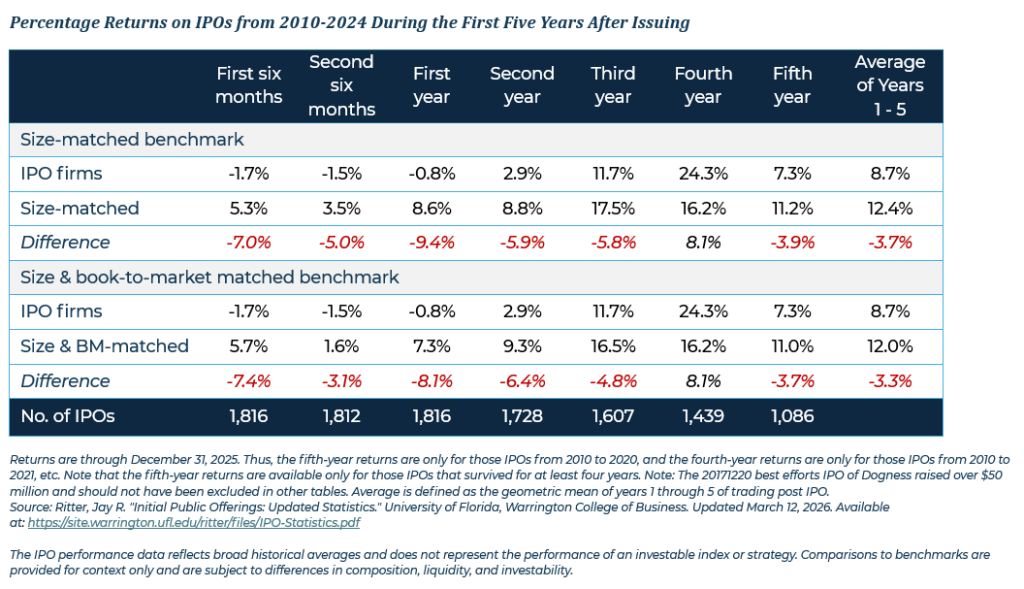
Historically, IPOs underperformed comparable publicly listed companies, a dynamic that is well documented in studies going back to the 1980s and still holds today. Recent data between 2010 and 2024 reflect the same story; in years one and two, IPOs lag benchmarks significantly, by roughly 8 to 9% in year one and 6% in year two, based on size-matched benchmark comparisons in the referenced dataset.
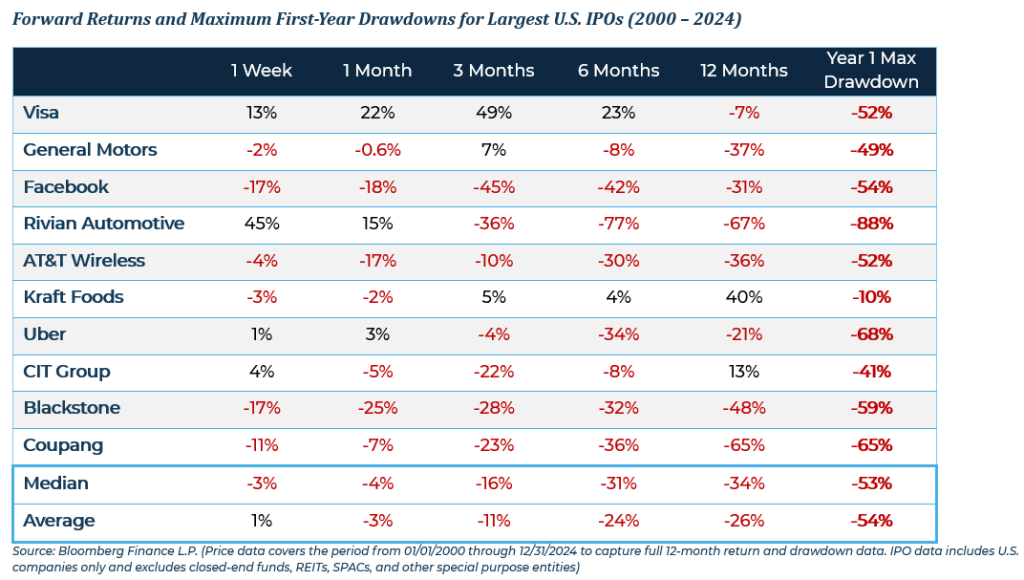
Perhaps more telling than the average return profile is the path those returns take. Even in cases where IPOs ultimately go on to succeed, the early experience for investors is rarely smooth. In the sample of largest U.S. IPOs since 2000 shown here, each experienced a drawdown of at least 10% within its first year of trading, with a median maximum drawdown exceeding 50%. While this is a limited sample, it reinforces how even the largest, high-profile public offerings have historically been accompanied by significant volatility.
Understanding why this happens is an important nuance. IPO pricing often reflects a high degree of optimism, with valuations that already embed strong expectations for growth and execution. At the same time, the supply of publicly available shares is initially limited, with insiders and early investors typically subject to lockup periods. It creates a dynamic where demand outstrips supply in the early days, but where additional shares gradually enter the market over time, often putting pressure on prices. These dueling forces layer into the nuance of the business, limited public market operating history and prevailing macro forces, it becomes clear why early price discovery can be both volatile and uneven.
The Broad Market Impact From IPOs
How will SpaceX, Anthropic, OpenAI anticipated IPOs impact market indexes?
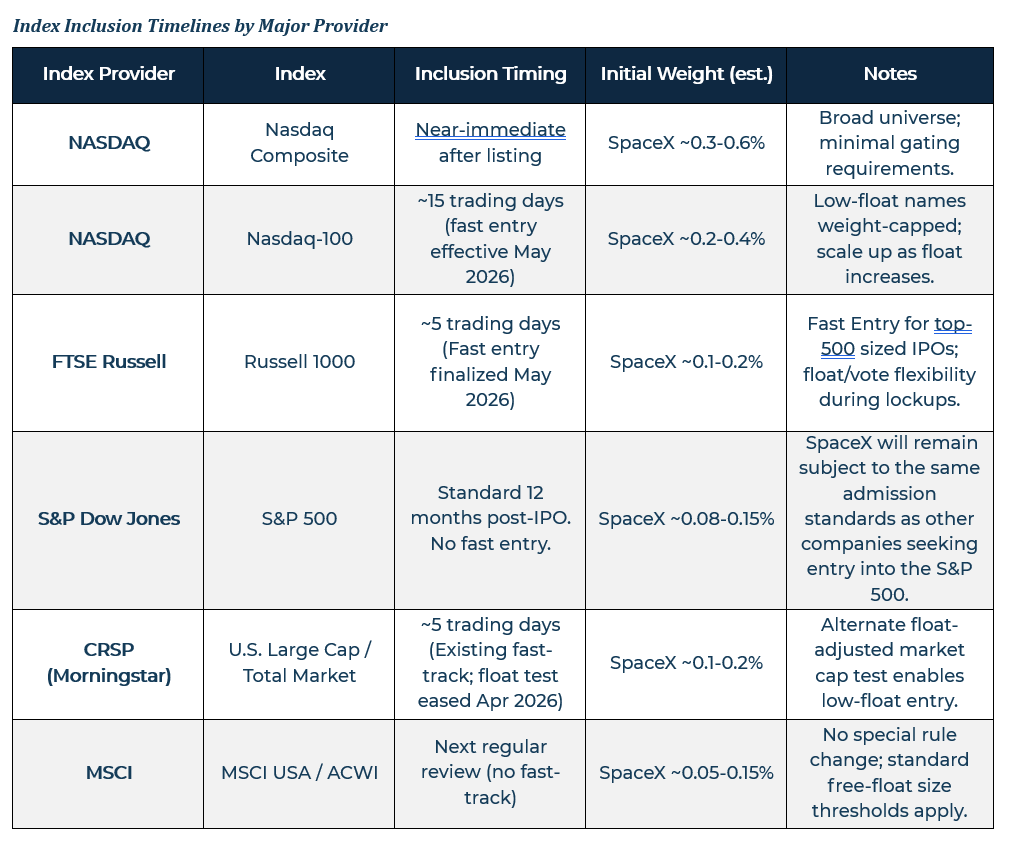
Each index provider has its own rules for when and how newly public companies are added. Historically, most required a seasoning period after an IPO before a company becomes eligible. However, the scale of currently proposed listings appears to be prompting providers to revisit long-standing criteria.
There are a few important points to keep in mind:
- While pending IPOs (SpaceX, OpenAI, Anthropic, etc.) are expected to set a new highwater mark on valuation, the actual number of shares listed on the exchange (also known as the float) is anticipated to be in the single-digit percentages of total ownership. Many initial holders of the publicly traded shares will also be subject to a 6-month lock-up period.
- IPO shares are expected to be included in most major U.S. equity indexes within 5 to 15 days post-IPO, with the exception of the S&P and MSCI indexes (though timing and inclusion are subject to change).
- Given the small float initially available, weightings for names are expected to be less than 0.30% each, if not smaller.
- Most passive providers (e.g. Vanguard, State Street, Blackrock) are expected to follow the lead of the index providers to include positions within their products and at what weight.
What to Know About Accessing IPOs
How can clients participate in upcoming IPOs such as SpaceX, OpenAI, and Anthropic?
Access depends on the custodian and the specific offering. IPO allocations typically flow through a tiered structure:
- Lead underwriters: Lead underwriters and investment banking partners will often receive the largest segment of allocations.
- Syndicate members: Co-managers and syndicate members receive smaller portions to distribute to their clients.
- Custodial platforms: Custodial platforms may participate if they are included as part of the distribution for a specific deal.
Ability to access will depend on demand and supply. For high-profile IPOs, demand tends to exceed supply therefore allocations are often scaled back leaving investors with meaningfully smaller positions than what they request. For those that do not gain access to shares during the IPO, they can simply purchase the shares after it goes public.
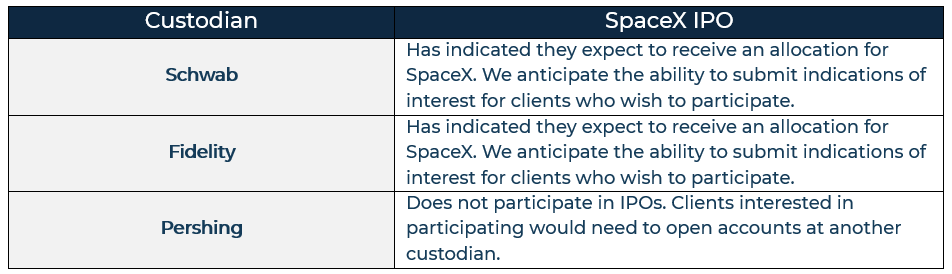
How do Pershing, Schwab, and Fidelity Intend to handle the SpaceX IPO access?
IPO participation may not be appropriate for all investors and should be evaluated on a case-by-case basis within client portfolios. We are actively working with each of our primary custodians to assess what access may be available. Clients will need to provide their written authorization for participation using a prescribed script.
Are There Any Potential Benefits to Buying an IPO?
There are reasons IPOs attract investor attention, but the risks are notable and worth understanding clearly.
Potential benefits:
- Early access to companies with strong growth narratives or market leadership in emerging industries
- The possibility of price appreciation if the company executes well and the market assigns a higher valuation over time
Key risks:
- Early trading is often volatile, and elevated expectations can make the initial risk/reward profile less attractive
- Many newly public companies are not yet profitable. For example, the combined SpaceX and xAI entity generated losses of $4.94 billion last year on revenue of $18.67 billion
- (Source: Morningstar, Securities Filings as of 05/02/2026)
- Valuations at IPO often reflect a significant premium relative to peers, implying a high level of embedded optimism that may or may not be justified
- Allocation uncertainty is common. Even when retail platforms participate, demand for high-profile IPOs far exceeds supply, and investors typically receive only a fraction of what they request
Conclusion
Bringing this together, the tension around IPO investing is evident. Underlying companies can be attractive, and in many cases, they go on to play an important role in markets, portfolios and the economy. But the IPO itself, meaning simply the moment when shares first become publicly available, is rarely the most favorable point of entry.
As investors, this context creates an opportunity to reframe the conversation. Rather than focusing on access to a specific transaction we should frame it as if, when, and how we choose to gain exposure to the underlying business. In many cases, a measured approach which allows the company to transition into the public markets, for liquidity to improve, and for valuation to adjust, can lead to a less volatile path to ownership. In that sense, IPOs become less about missing an opportunity, and instead about understanding the timing of when an opportunity naturally transitions into a portfolio without creating a negative drag.
Wealthspire Advisors LLC, Fiducient Advisors LLC, Wealthspire Retirement, LLC, and certain of its affiliates are separately registered investment advisers. © 2026 Wealthspire
Wealthspire and its representatives do not provide legal or tax advice, and Wealthspire does not act as law, accounting, or tax firm. Services provided by Wealthspire are not intended to replace any tax, legal or accounting advice from a tax/legal/accounting professional. The services of an appropriate professional should be sought regarding your individual situation. You should not act or refrain from acting based on this content alone without first seeking advice from your tax and/or legal advisors.
Certain employees of Wealthspire may be certified public accountants or licensed to practice law. However, these employees do not provide tax, legal, or accounting services to any of clients of Wealthspire, and clients should be mindful that no attorney/client relationship is established with any of Wealthspire employees who are also licensed attorneys.
This material should not be construed as a recommendation, offer to sell, or solicitation of an offer to buy a particular security or investment strategy. The information provided is for informational purposes only and should not be relied upon for accounting, legal, or tax advice. While the information is deemed reliable, Wealthspire cannot guarantee its accuracy, completeness, or suitability for any purpose, and makes no warranties with regard to the results to be obtained from its use.
Please Note: Limitations. The achievement of any professional designation, certification, degree, or license, recognition by publications, media, or other organizations, membership in any professional organization, or any amount of prior experience or success, should not be construed by a client or prospective client as a guarantee that he/she will experience a certain level of results or satisfaction if Wealthspire is engaged, or continues to be engaged, to provide investment advisory services, nor should it be construed as a current or past endorsement of Wealthspire by any of its clients or a third party.
Registration of an investment advisor does not imply that Wealthspire or any of its principals or employees possess a particular level of skill or training in the investment advisory business or any other business.
Past performance is no guarantee of future results. Different types of investments involve varying degrees of risk. Therefore, there can be no assurance that the future performance of any specific investment or investment strategy, including the investments and/or investment strategies recommended and/or undertaken by Wealthspire, or any non-investment related content, will be profitable, equal any corresponding indicated historical performance level(s), or prove successful. No amount of prior experience or success should be construed that a certain level of results or satisfaction will be achieved if Wealthspire is engaged, or continues to be engaged, to provide investment advisory services.
Historical performance results for investment indices, benchmarks, and/or categories have been provided for general informational/comparison purposes only, and generally do not reflect the deduction of transaction and/or custodial charges, the deduction of an investment management fee, nor the impact of taxes, the incurrence of which would have the effect of decreasing historical performance results.
The information contained herein is confidential and the dissemination or distribution to any other person without the prior approval of Fiducient Advisors is strictly prohibited. Information has been obtained from sources believed to be reliable, though not independently verified. Any forecasts are hypothetical and represent future expectations and not actual return volatilities and correlations will differ from forecasts. This report does not represent a specific investment recommendation. The opinions and analysis expressed herein are based on Fiducient Advisor research and professional experience and are expressed as of the date of this report. Please consult with your advisor, attorney and accountant, as appropriate, regarding specific advice. Past performance does not indicate future performance and there is risk of loss.